01PREVENT
Reduce opportunities for misuse.
Short-lived entry credentials, ticket-state validation, account verification and controlled seat reservations.
01INDEPENDENT PERSONAL PROJECT
Rethinking how event ticketing can combine secure admission, fair purchasing, risk investigation and controlled enforcement.
Independent engineering project inspired by Aung Za Bu's live-performance context. Not commissioned, endorsed or officially affiliated with the artist.
02THE PROBLEM
A secure ticketing product has to consider everything from booking integrity to the moment a person enters an event.
What if ticketing were designed around trust, rather than simply completing a transaction?
The Aung Za Bu performance context became the inspiration for my independent engineering case study.
I explored common challenges in high-demand ticketing: duplicated credentials, purchasing limits, different ticket-issuance channels and decisions about suspicious activity.
Copied or reused entry credentials
Multiple accounts and purchase-limit evasion
Online, guest, sponsor and offline tickets
Evidence-based administrative decisions
These are design risks and hypotheses, not verified claims about incidents at Aung Za Bu events.
03SOLUTION APPROACH
Three connected responsibilities, each with its own objective, evidence requirements and safeguards.
Short-lived entry credentials, ticket-state validation, account verification and controlled seat reservations.
Link relevant account and device activity, identify risk patterns and organize findings for human investigation.
Review affected accounts and tickets, confirm the intended impact and record administrator-controlled actions.
04BOOKING & PAYMENT
A booking interface is only trustworthy when the backend protects seat ownership under concurrent requests.
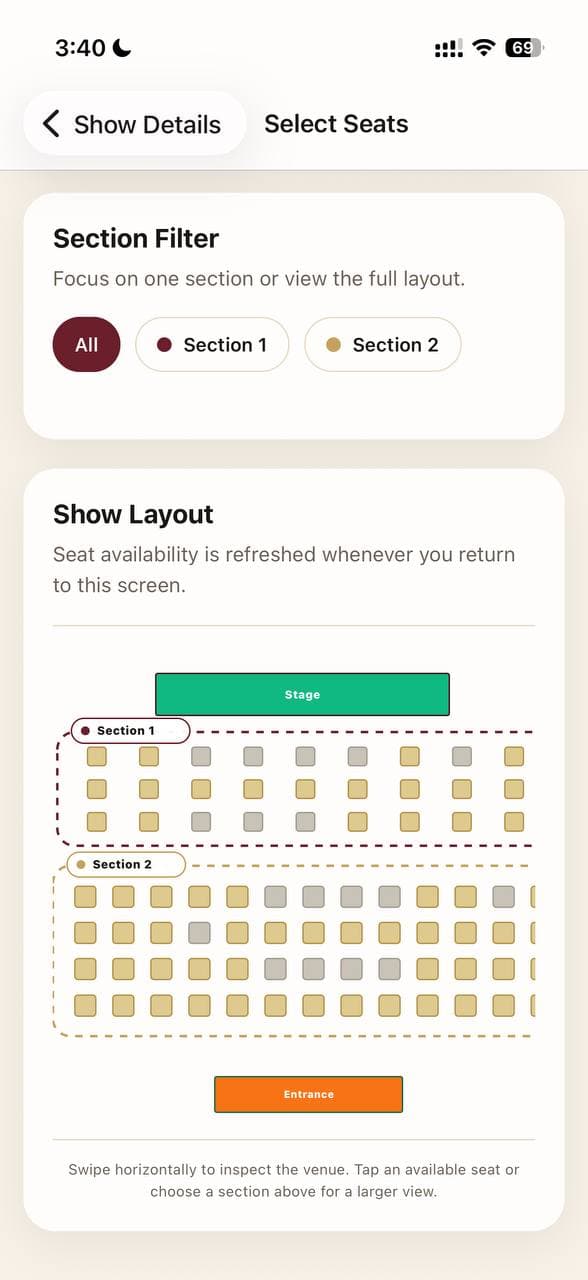
Fan selects available seats.
Server creates a time-bound reservation.
Payment enters its review lifecycle.
Approved bookings lead to ticket issuance.
PostgreSQL transactions and locking coordinate competing seat reservations and payment-state transitions.
05SECURE ADMISSION
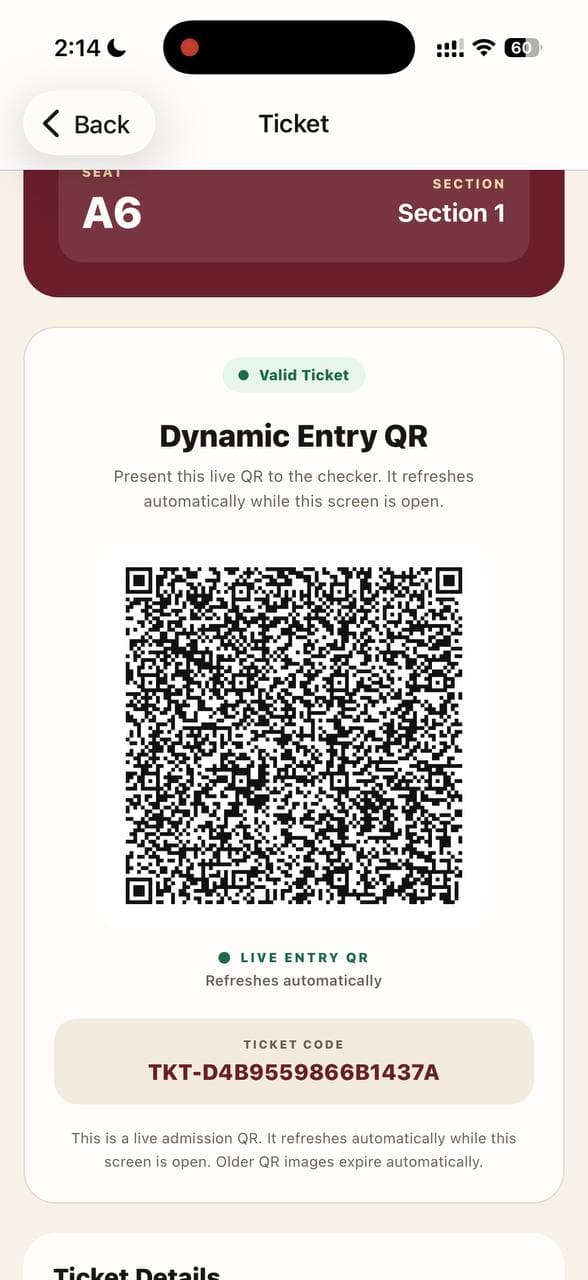
Online admission relies on short-lived signed credentials and server-side ticket eligibility checks.
Each credential expires quickly and is validated against the current ticket, booking and seat state.
Guest, sponsor and offline holders can verify with either an identity fragment or an SMS one-time code.
Sensitive personal and payment data is excluded from dynamic QR payloads.
06RISK DETECTION
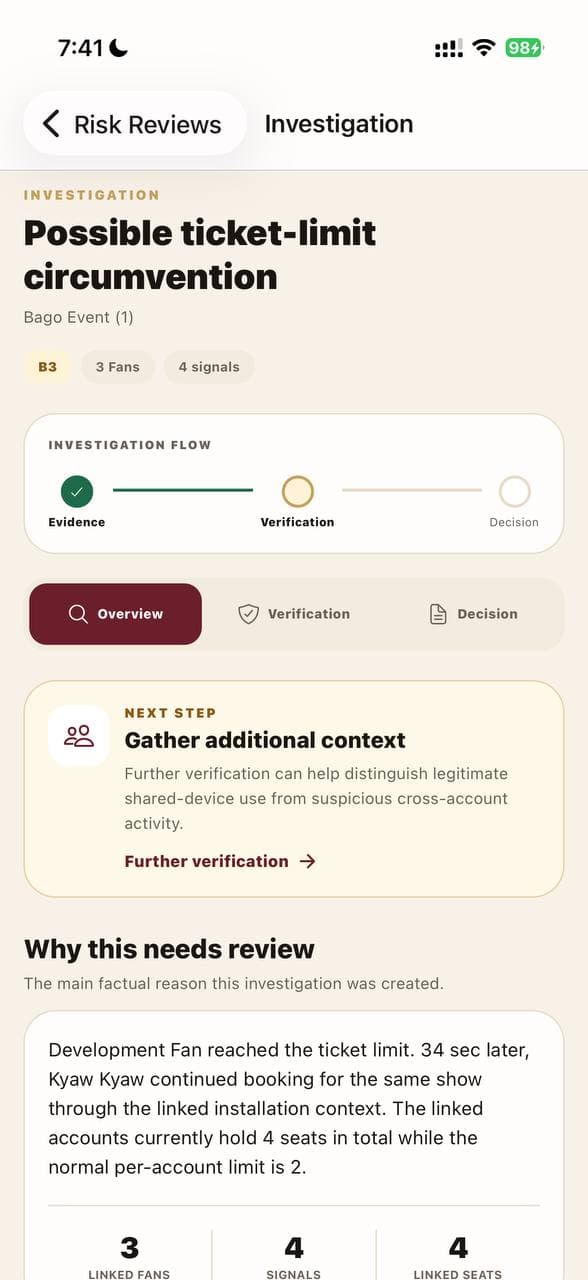
A shared device or related purchasing activity may deserve review, but should not automatically imply abuse.
Related accounts, occurrences and device observations
Patterns that may indicate circumvention attempts
Supporting timelines, signals and next steps
The configured device-risk enforcement policy currently operates in shadow mode.
07CONTROLLED ENFORCEMENT
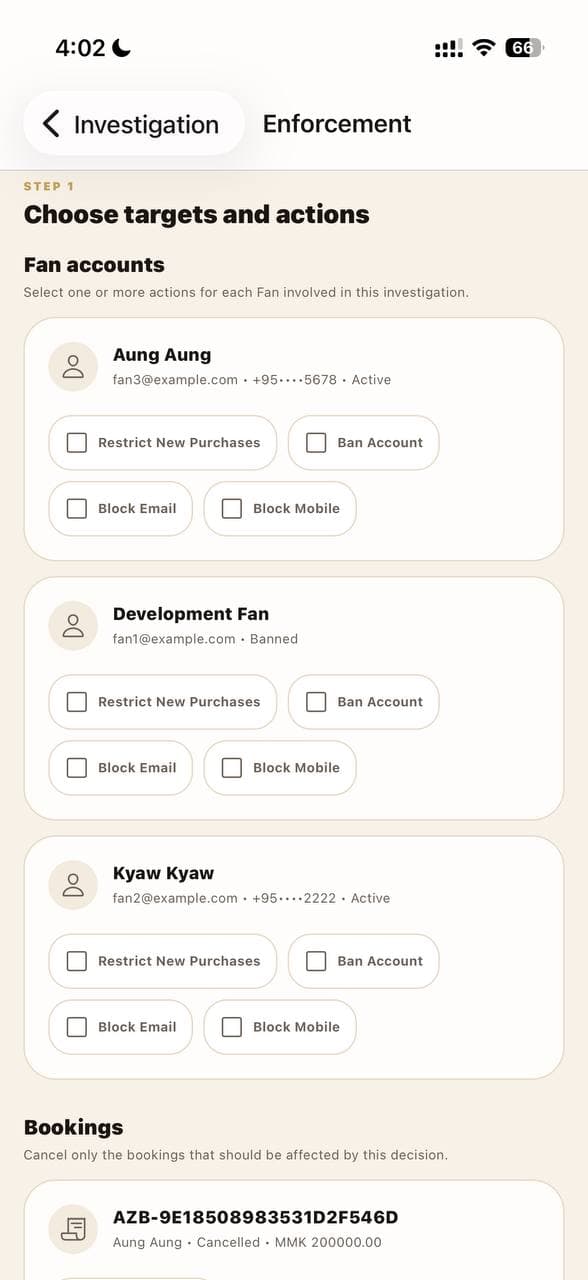
An administrator should understand the consequences of an action before executing it.
Supported administrative actions include purchase restrictions, account bans, identifier blocks, booking cancellations and ticket revocations.
08SYSTEM ARCHITECTURE
The system separates user experiences, application services and transaction-backed data.
Fan · Administrator · Checker
Authentication · Commerce · Verification · Risk
Inventory · Ticket state · Audit records
Hashed credentials, rotating sessions and access controls.
Encryption and keyed lookups for sensitive holder information.
Locks, atomic updates and idempotent operations.
Simplified conceptual architecture—not a deployment or infrastructure diagram.
09ENGINEERING CHALLENGES
Correct behavior matters most when multiple requests arrive together or a network response is lost.
Multiple fans compete for the same inventory without multiple successful owners.
Concurrent administrative operations must leave payment and ticket state consistent.
Repeated offline-sale requests must not duplicate a committed sale.
Competing entry and verification operations must respect the ticket lifecycle.
10THE ENGINEERING TAKEAWAY
This project challenged me to think beyond screens and endpoints: inventory ownership, identity, failure recovery, privacy, evidence and the consequences of enforcement decisions.