Delayed communication
Reporting a problem could require leaving the workstation.
01INDUSTRIAL CAPSTONE
GlassSync is a web-based operational platform developed through an SUTD capstone collaboration with PT Muliaglass.
A shared workflow for defect communication, hourly production reporting and structured shift handovers between factory teams.
02THE INDUSTRIAL PROBLEM
The starting point was a physical communication gap between manufacturing operations.
How can two production teams coordinate defects and shift information without relying on repeated physical handovers?
Cold End and Hot End teams needed faster, clearer communication about production issues.
The project report described a factory environment in which operators sometimes needed to travel between work areas to communicate defects. Information could become fragmented across people, shifts and records.
Reporting a problem could require leaving the workstation.
Teams needed a common view of defects and their current status.
Outstanding issues and production context needed to remain visible across handovers.
03THE SOLUTION
A common system connecting production setup, defect tracking, reports and operator handovers.
Inspection, defect review and follow-up
One source of operational information
Defect response, production updates and handover
Report, monitor and resolve production defects.
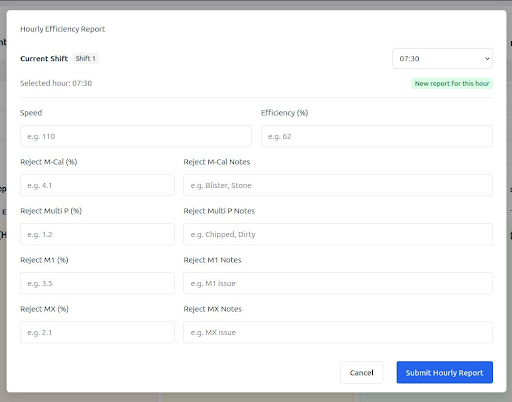
Record speed, efficiency and rejection information.
Preserve operator notes and relevant shift history.
Review consolidated production and defect information.
04DEFECT REPORTING
A defect should remain visible through its operational lifecycle.
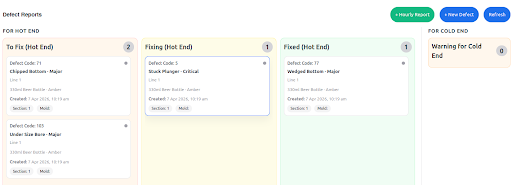
Reported and awaiting action
Work currently in progress
Resolution recorded
GlassSync provides a common view of defect categories, status changes and operational information for the relevant teams.
Project-level featureThe defect board is presented here as a team deliverable, distinct from the features I personally took ownership of.
05MY CONTRIBUTION / HOTO
I developed the Hand-Over / Take-Over workflow as part of my frontend and backend contribution.
Shift handover interactions, operator notes, backend integration and the retrieval of previous handover information.
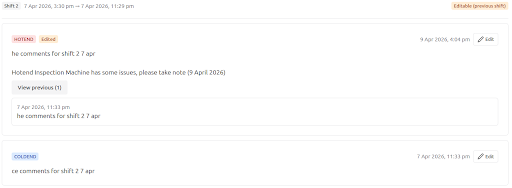
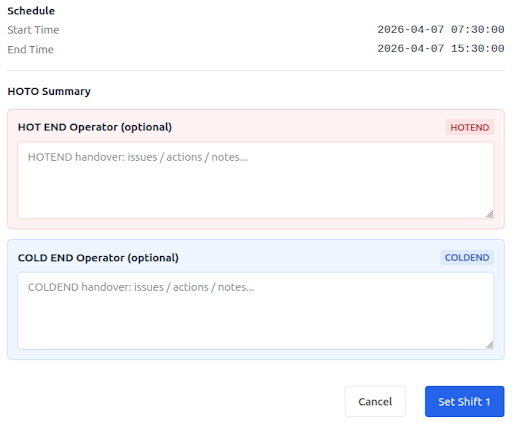
Capture Hot End and Cold End handover notes.
Associate handover records with shift context.
Display earlier notes for continuity and review.
06MY CONTRIBUTION / REPORTING
I also contributed to GlassSync's hourly reporting functionality.
Production measurements needed a structured workflow instead of disconnected entries.
Hourly operational measurements
Production rejection rates and notes
Reports associated with the relevant operating period
Contribution scopeI worked on hourly reporting as part of the technical team. This is distinct from my HOTO implementation ownership.
07TECHNICAL ARCHITECTURE
The platform uses a web frontend, application API and relational data layer.
Operational dashboards, forms and workflows
REST APIs and business logic
Shifts, defects, reports and production records
Interfaces designed around day-to-day production tasks and reporting.
APIs linking shift context, submissions and persistent operational records.
React, Express, REST services and containerized local development.
Simplified system architecture. My personal contribution spanned frontend and backend work; the overall platform was developed as a team.
08INTERNAL EVALUATION
A usability benchmark for defect submission, reported during the team's internal evaluation.
These figures describe the internal defect-reporting task, not the HOTO workflow or hourly reporting.
Internal defect submission
Average interactions per submission
Time target
≤ 25 secondsInteraction target
≤ 15 interactionsThis was internal prototype testing. It does not establish factory-wide deployment performance or independently measured production efficiency gains.
09ENGINEERING TAKEAWAYS
GlassSync taught me to translate real industrial needs into interfaces, APIs and workflows that support communication across teams and shifts.
Design around actual operator workflows.
Make frontend and backend behavior coherent.
Keep important information available across shifts.